
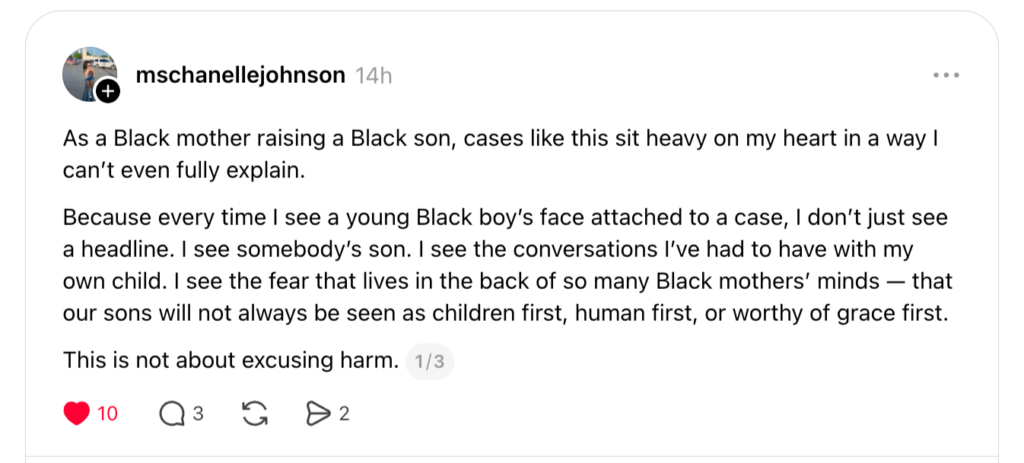
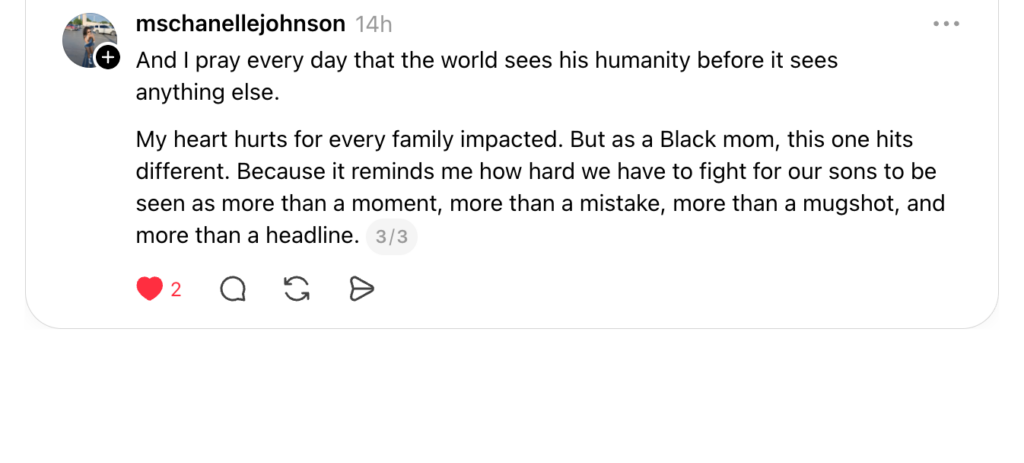
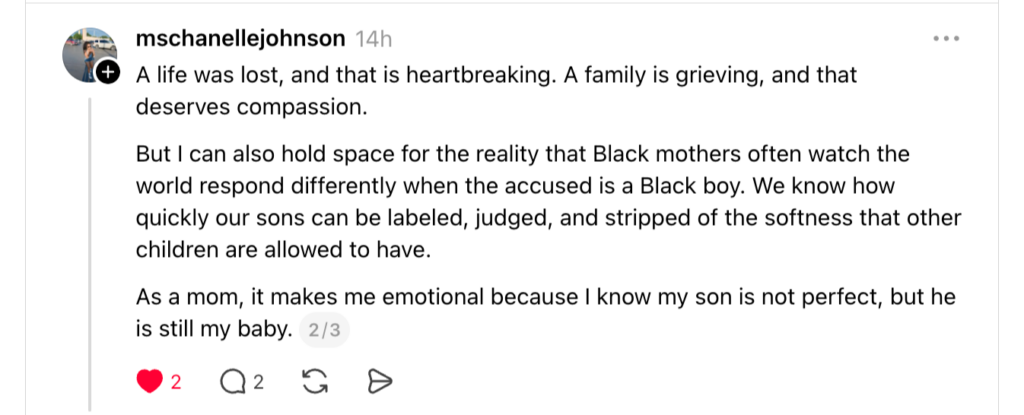
I have been overwhelmed with grief regarding the Karmelo Anthony case.
It started last year when I heard about Austin Metcalf being stabbed and dying. How awful for a young man to lose his life. How devastating for his parents, siblings, family, and friends. I cannot imagine that kind of loss, and I continue to pray for everyone who loved him.
I was also grieved wondering what could have led Karmelo Anthony to respond the way he did. I thought about how one moment, one decision, could completely alter the course of a young person’s life.
That grief returned last week as his jury selection began. Anthony, a teenaged black boy, was denied a jury of his peers, no matter how news outlets or anyone else wants to paint it. With not one black juror who looked like him present and who possibly had similar experiences and backgrounds like him to empathize and relate to his lived experience, no one can truly say he would be tried by a jury of his peers. And the claims that black jurors were dismissed because they couldn’t be unbiased yet somehow other races could be unbiased is an egregious assumption.
I have prayed daily for everyone involved in this case: Anthony, his family, his attorneys, and the Metcalf family as they continue to relive some of the worst moments of their lives. This was a terrible and tragic situation all around.
Then, after eight days of testimony and only a few hours of deliberation, the jury convicted Anthony of murder. Not long after, he was sentenced to 35 years in prison.
My heart broke.
Just as it has broken time and time again when I have watched Black people struggle to receive justice in this country. My grief has moved between rage and exhaustion.
What has troubled me from the beginning is how Karmelo Anthony has been perceived and discussed.
He was 17 years old when this happened.
A child.
A boy.
Yet Karmelo was not afforded the grace often extended to children. Black boys rarely are.
Black boys don’t get to have good days and bad days. Black boys don’t get to be works in progress. Black boys can’t have underdeveloped brains and raging hormones that drastically affect what they do in their growing bodies.
Black boys are not often granted the same understanding for immaturity, impulsivity, underdeveloped judgment, or poor decisions that others receive.
Black boys don’t get the benefit of the doubt.
Black boys don’t get to be human beings first.
Because Austin Metcalf was a boy and a human being whose life should be mourned. He had good days and bad days. He made mistakes. He was a teenager trying to figure out life.
But too often, Black boys are denied that same humanity.
Because of his Black skin, many people seem unable to imagine Karmelo Anthony as a teenager who may have acted out of fear, confusion, poor judgment, immaturity, trauma, or any number of complicated human emotions. The possibility that he was anything other than a violent aggressor appears unimaginable to many.
And that is exhausting.
Trayvon Martin was also 17 years old.
He was unarmed and walking home with a bag of Skittles and a drink. George Zimmerman, a 28-year-old man carrying a gun, followed him despite being advised not to do so. Zimmerman ultimately shot and killed him, claiming he feared for his life.
Yet for months, people painted Trayvon as the aggressor.
Of course he must have attacked first.
Of course he must have been violent.
Of course he somehow deserved what happened to him.
Trayvon was not granted the presumption of innocence often afforded to children. The possibility that a teenager might have been frightened by an armed adult following him was dismissed by many before it was ever seriously considered.
Because Trayvon Martin was a Black boy.
Black boys don’t get to be boys like every other race. Black boys don’t get humanity. Black boys don’t get understanding, and they definitely don’t get empathy.
That reality is maddening. And exhausting.
There is so much to unpack in the Karmelo Anthony-Austin Metcalf tragedy: black people getting harsher sentences than other races, the criminal justice system always failing to serve black people justice, the hypocrisy of stand your ground laws when the one standing their ground is black . . . I could go on and on.
People online can argue endlessly that Anthony should not have brought a knife to the track meet or that he should have simply walked away. Those conversations will continue.
But let’s also be honest about the fact that some young people are routinely afforded grace that others never receive.
Ethan Couch was allowed to be a 16-year-old Texas boy suffering from “affluenza.” Despite killing four people and injuring others while driving drunk, he received probation and rehabilitation instead of prison.
Kyle Rittenhouse was widely described as a frightened 17-year-old acting in self-defense. He was acquitted of all charges related to the shooting deaths of two people and the wounding of another.
Examples like these are often cited because they raise difficult questions about who receives understanding, who receives second chances, and who is viewed as redeemable.
Unfortunately, there is also a long list of Black children who were never afforded that same consideration.
It is heartbreaking.
It is maddening.
And it is exhausting.
As the mother of a Black son, this reality hits especially close to home.
It hurts to know that one day people may stop seeing my sweet, precious child as the innocent boy he is.
Black boys deserve the freedom to grow, learn, make mistakes, and experience childhood the same way other children do. Black boys deserve empathy. Black boys deserve understanding. Black boys deserve to be seen as human beings.
That is what has been so painful about the response to this case.
Many things can be true at the same time. Austin Metcalf’s life mattered. His death is tragic, and his family deserves compassion as they grieve a loss that never should have happened.
Karmelo Anthony’s humanity matters too.
And so does the reality that he was a child.

I cannot fathom the pain of losing a child but I know the pains of losing a loved one-it hurts regardless. My heart goes out to both families. Unfortunately, it seems like a life for a life but is that really justice? To purposely impose hurt on another because you are hurting? Racism involved? I don’t know the entire story; however, I do know from past experience that unfair treatment was involved. I believe emotions were really high, too high to make sound deliberations and verdicts. I believe it should have been a mixed jury, not all one race. I also believe that if tables were turned (races exchanged positions), the verdict would have been different. I believe that because there are so many cases that this happened. Blacks treated unfairly because of race. Both families lost during this difficult time. I believe there should be consequences for the action. I strongly believe the consequence should match the crime-but the crime need to be clear and not questionable before the consequence is rendered. Prayers out to all of the families.